
Introduction
Before we jump into the topic, we invite you to do a little experiment. Wherever you are right now, point your finger to the sky, look up, and begin to draw a clockwise circle. Continue tracing the clockwise circle as you lower your arm until it’s at chest height. Look down at the circle your hand is now tracing – which direction is it moving?

Whoa! That once-clockwise circle is now a counter-clockwise circle – mindblown, we know. This illustrative practice is a popular one among facilitators, because of the visceral metaphors that come along with the process of shifting your point of view, and seeing the circle in a totally different way. To take that practice one step deeper, we invite you to take 2 minutes to reflect on a moment when something you encountered caused you to rethink or reshape one of your ideas, perspectives, or beliefs. You can use the timer below to time yourself:
https://www.youtube.com/watch?v=3iZg1xBW4tA
Largely driven by a broader cultural emphasis on mindfulness, self-improvement, and mental well-being, reflection has become a prominent term that has permeated nearly every facet of society. Reflection can offer a counterbalance to the speed and external focus of modern life, proving to be a powerful and actionable tool for navigating an increasingly complex yet disconnected world.
For those individuals, groups, and organizations choosing to embark in the pursuit of finding meaning and purpose, there is a required level of introspection that fosters curiosity, engagement, and intentionality. This concept of an “inward focused lens” is not new. In fact, philosophers like Socrates and Lao Tzu have been writing about the importance of reflection since time immemorial. Aristotle even surmised that “knowing yourself is the beginning of all wisdom,” and while there is value in “knowing all wisdom,” the simple act of reflection goes beyond the pursuit to “know all” by offering us a deeper sense of understanding and connection to oneself and those around us.
Whether in the classroom, the sports field, or in the boardrooms of the corporate world, the power of reflection has proven invaluable in our understanding of growth, learning, and development. Imagine a sports team that never looked back at their old games to analyze what they could improve upon, or an advertising agency that never did any sort of assessment before launching a multi-million dollar marketing campaign. Early American educational reformer John Dewey said it succinctly, “We do not learn from experience. We learn from reflecting on experience.” In short: Reflection is Learning!
Shared Experiences are Stronger
A 2014 study by Boothby, Clark, & Bargh explored how sharing an experience changes how we feel about it–and about each other. In the first part of the experiment, paired participants silently ate a tasty piece of chocolate either at the same time (i.e. shared) or while the partner looked at art (i.e. not shared). When the chocolate was shared, people rated it as richer and more enjoyable, and reported feeling more connected to their partner.

The researchers then asked whether sharing always improves an experience, or simply intensifies it. In a second round, participants ate an extremely bitter chocolate under the same paired conditions, except instead of viewing art the partner had to look through a catalog of calculators (riveting, right?). When the unpleasant experience was shared, the chocolate tasted worse, yet participants felt more attuned to their partner and more absorbed in the experience.
The takeaway: shared experiences are amplified–pleasant or unpleasant–because they prompt us to “mentalize,” or tune into what another person is thinking and feeling. It’s because of mentalizing that during unpleasant shared experiences like a dull training, a rough first job, or an awkward “team building” activity can still bring people closer. When we make space for shared experiences, we strengthen trust, deepen enjoyment, and even draw meaning from the moments we’d rather forget – turning them into valuable learning lessons!
Reflection Activities
In learning any new skill, competency and mastery come with time, patience, and experience. The practice of reflection is no different. Choosing the “right act” of reflection or the “right” tool can seem pretty daunting at first. Which tool is the best for you? What type of reflection is appropriate for the circumstances? How long or often should a reflection be? What is the purpose of reflection at this moment? Thankfully there are many ways that we can explore and experiment with an array of tools and strategies that best suit our needs.
The beauty of reflection is that there is no “right” or “wrong” way to reflect. The tools we implement can be as diverse, adaptable and unique as the instances in which you need to reflect.
- Structured techniques:
- Gibbs’ Reflective Cycle (1998) is a six step model that guides you through describing an experience, feeling it, evaluating it, analyzing it, concluding what you learned, and creating an action plan for the future.
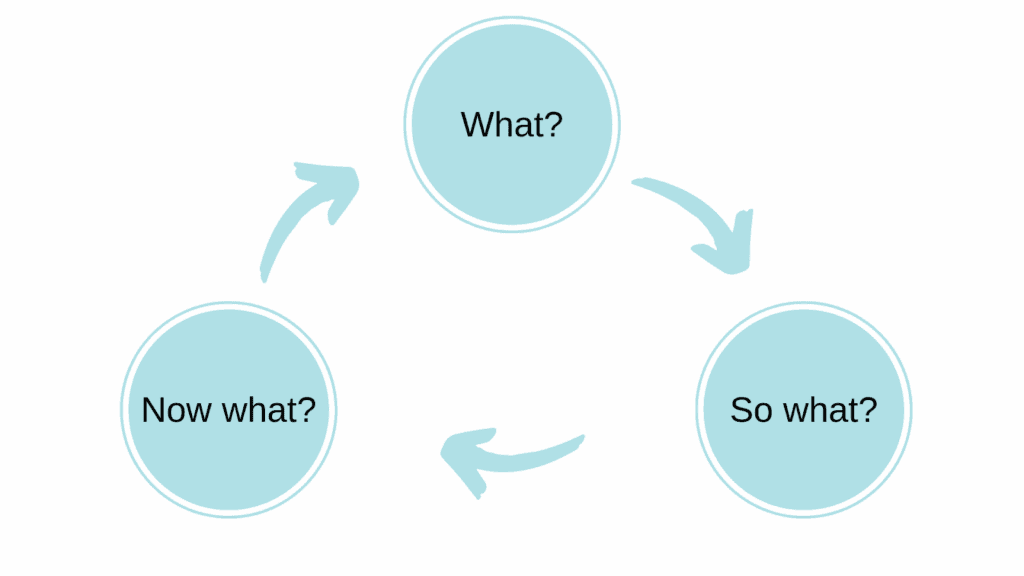
- Borton/Driscoll What Model (1970, 2007) is a popular and easy-to-follow framework for analyzing our insights from experiences: What? So What? Now What?
- Journaling
- Visual
- PhotoVoice–photographs and narratives gathered to guide actions
- Mind maps and diagrams. Great for visual organization of ideas, notes, and connections between them.
- Artistic methods. You can use images, postcards, drawings, or trinkets to represent what words cannot capture.
- Gratitude
- 3 things you’re grateful for today?
- Use Prompts
- To guide your writing, start with questions like, “what did I learn today?” or “What challenges did I face during this project?”
- Visual
- Observe and Connect to nature:
- Take the time to slow down in nature and see how the patience of a plant growing can teach you about perseverance, or how a river carves its path over time, much like a consistent effort can shape your life.
- Mindful movement
- Allow your mind to wander and process thoughts without pressure while doing
- Simple/mundane tasks like laundry, showering, eating, etc. are great opportunities to slow down,be present and mindful of how we move through the day especially with tasks we often don’t give any second thought about
Invitation
At the end of the calendar year, we often find ourselves in a slightly different pace and mindset. We invite you to block of 5 minutes of time for yourself before getting fully into the unplugged/Holiday mode and reflect on the following questions:
- My biggest accomplishment in 2025 was . . .
- Something I want to stop doing in 2026 is . . .
- I felt most successful in 2025 when . . .
Remember, how you react to the questions is up to you–you can write it, you can speak it, you can capture it in images, you can craft it into a metaphor. After you’ve had a chance to reflect by yourself, we invite you into creating a shared experience by finding a trusted colleague and asking them if they’d be willing to let you share your responses, and if they’d share theirs.